Lineage tracing of drug-tolerant persister cells
This tutorial applies CloneOT to the Watermelon lineage-tracing study (Oren et al., Nature 2021). PC9 lung cancer cells carrying lineage barcodes were treated with osimertinib and profiled before treatment (day 0) and on days 3, 7 and 14. We learn the transport cost from the clones and predict the response of day-0 cells on day 3.
You will learn how to
load a lineage-tracing dataset as AnnData,
hold out cells of seen clones and entire unseen clones for evaluation,
train CloneOT and, on the same representation, CloneOT without lineage,
evaluate the predictions clone by clone,
save and reload a model.
A GPU is recommended. With about 20,000 cells, each model trains in several minutes.
import time
import numpy as np
import pandas as pd
import matplotlib.pyplot as plt
import cloneot as cot
Data
cot.datasets.watermelon downloads the processed counts and the lineage barcodes from GEO (GSE150949, 125 MB) on the
first call and caches an AnnData object. Cells with exactly one barcode have a clone label in obs['clone']. Cells
with several barcodes, which may come from several integrations or doublets, have none.
adata = cot.datasets.watermelon('data')
adata
AnnData object with n_obs × n_vars = 56419 × 22166
    obs: 'clone', 'lineage_block', 'day', 'condition', 'sample', 'fraction', 'replicate'
    uns: 'source'
adata.obs.groupby(['condition', 'fraction'], observed=True).agg(cells=('clone', 'size'), labeled=('clone', 'count'))
| cells | labeled | ||
|---|---|---|---|
| condition | fraction | ||
| day0 | unsorted | 6778 | 3581 |
| day3 | unsorted | 14366 | 7345 |
| day7 | unsorted | 8285 | 3541 |
| day14 | cycling | 6843 | 1834 |
| moderate | 9318 | 3708 | |
| non-cycling | 10829 | 5361 |
adata = adata[adata.obs.condition.isin(['day0', 'day3'])].copy()
Held-out cells
We hold out two kinds of test cells.
Unseen clones: all cells of 20% of the clones. These clones never appear in training.
Seen clones: 20% of the cells of every other clone with at least two cells on each day. These clones appear in training, but the held-out cells do not.
The held-out day-0 cells are the cells we predict, and the held-out day-3 cells of the same clones are the observed responses. All other cells train the models, including the cells without a clone label.
unseen = cot.datasets.holdout(adata, clone_key='clone', condition_key='condition', fraction=0.2, unit='clones')
seen = np.zeros(adata.n_obs, bool)
seen[np.flatnonzero(~unseen)] = cot.datasets.holdout(adata[~unseen], clone_key='clone', condition_key='condition',
                                                     fraction=0.2, unit='cells')
train = adata[~(seen | unseen)].copy()
tests = {'Seen clones': adata[seen].copy(), 'Unseen clones': adata[unseen].copy()}
print(f'{train.n_obs} training cells')
for name, test in tests.items():
    print(f'{name}: {test.n_obs} held-out cells of {test.obs.clone.nunique()} clones')
17777 training cells
Seen clones: 1159 held-out cells of 423 clones
Unseen clones: 2208 held-out cells of 616 clones
Training
CloneOTModel selects 2,000 highly variable genes, learns a VAE representation of both days, learns the transport cost
from the clones and fits the neural map. The defaults are the settings of the paper.
start = time.time()
model = cot.CloneOTModel(train, condition_key='condition', source='day0', target='day3', clone_key='clone')
model.train(verbose=False)
print(f'trained in {(time.time() - start) / 60:.1f} minutes')
trained in 10.9 minutes
For comparison, we train CloneOT without lineage on the same genes and VAE. Without clone labels, CloneOT is entropic optimal transport with the squared Euclidean cost.
start = time.time()
no_lineage = cot.CloneOTModel(train, condition_key='condition', source='day0', target='day3', clone_key=None)
no_lineage.train(representation=model, verbose=False)
print(f'trained in {(time.time() - start) / 60:.1f} minutes')
trained in 0.1 minutes
Evaluation
We evaluate every held-out clone on the 50 genes that change most between day 0 and day 3. For each clone, l2 and
r2 compare the predicted and the observed clone means, and energy is the energy score of the predicted cells
against the observed cells (lower is better). The clone-specific correlation r removes the response that all clones
share and measures how well the predictions capture the differences between clones.
genes = model.response_genes(50)
scores, rows = {}, []
for setting, test in tests.items():
    observed = model.observed(test)
    for name, m in [('Without lineage', no_lineage), ('CloneOT', model)]:
        s, r = cot.metrics.evaluate(m.predict(test), observed, clone_key='clone', genes=genes)
        scores[setting, name] = s
        rows.append(dict(setting=setting, method=name, l2=s.l2.mean(), r2=s.r2.mean(), energy=s.energy.mean(),
                         clone_specific_r=r))
pd.DataFrame(rows).set_index(['setting', 'method']).round(3)
| l2 | r2 | energy | clone_specific_r | ||
|---|---|---|---|---|---|
| setting | method | ||||
| Seen clones | Without lineage | 4.660 | 0.721 | 5.092 | 0.028 |
| CloneOT | 4.352 | 0.753 | 4.835 | 0.120 | |
| Unseen clones | Without lineage | 3.460 | 0.826 | 4.665 | 0.115 |
| CloneOT | 3.213 | 0.847 | 4.656 | 0.217 |
CloneOT is more accurate than the model without lineage on every metric, for both seen and unseen clones. To see that the gain is not driven by a few clones, we compare the two models clone by clone.
fig, axes = plt.subplots(1, 2, figsize=(8, 4))
for ax, setting in zip(axes, tests):
    cot.pl.paired_scores(scores[setting, 'Without lineage'], scores[setting, 'CloneOT'], metric='l2',
                         labels=('Without lineage', 'CloneOT'), ax=ax)
    ax.set_title(setting)
plt.tight_layout()
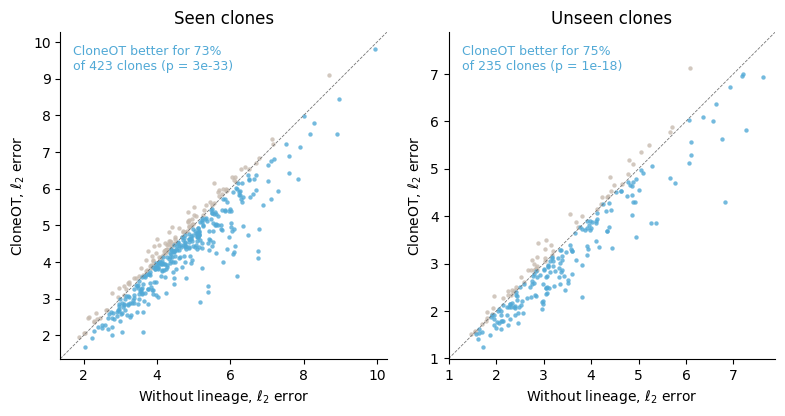
Each point is one held-out clone, with the \(\ell_2\) error of its predicted mean expression without lineage
(x-axis) and with CloneOT (y-axis). Blue points lie below the diagonal and mark the clones that CloneOT predicts more
accurately. The gain holds for most clones, both for seen clones and for unseen clones that never appeared in
training. metric='r2' or metric='energy' draws the same comparison for the other metrics.
Saving and loading
A trained model is saved with its genes, VAE and cost, and predicts new cells after loading.
model.save('watermelon_day0_day3')
loaded = cot.CloneOTModel.load('watermelon_day0_day3')
np.allclose(loaded.predict(tests['Unseen clones']).X, model.predict(tests['Unseen clones']).X, atol=1e-5)
True