CloneOT
Predicting clone-specific perturbation responses with lineage-supervised neural inverse optimal transport.
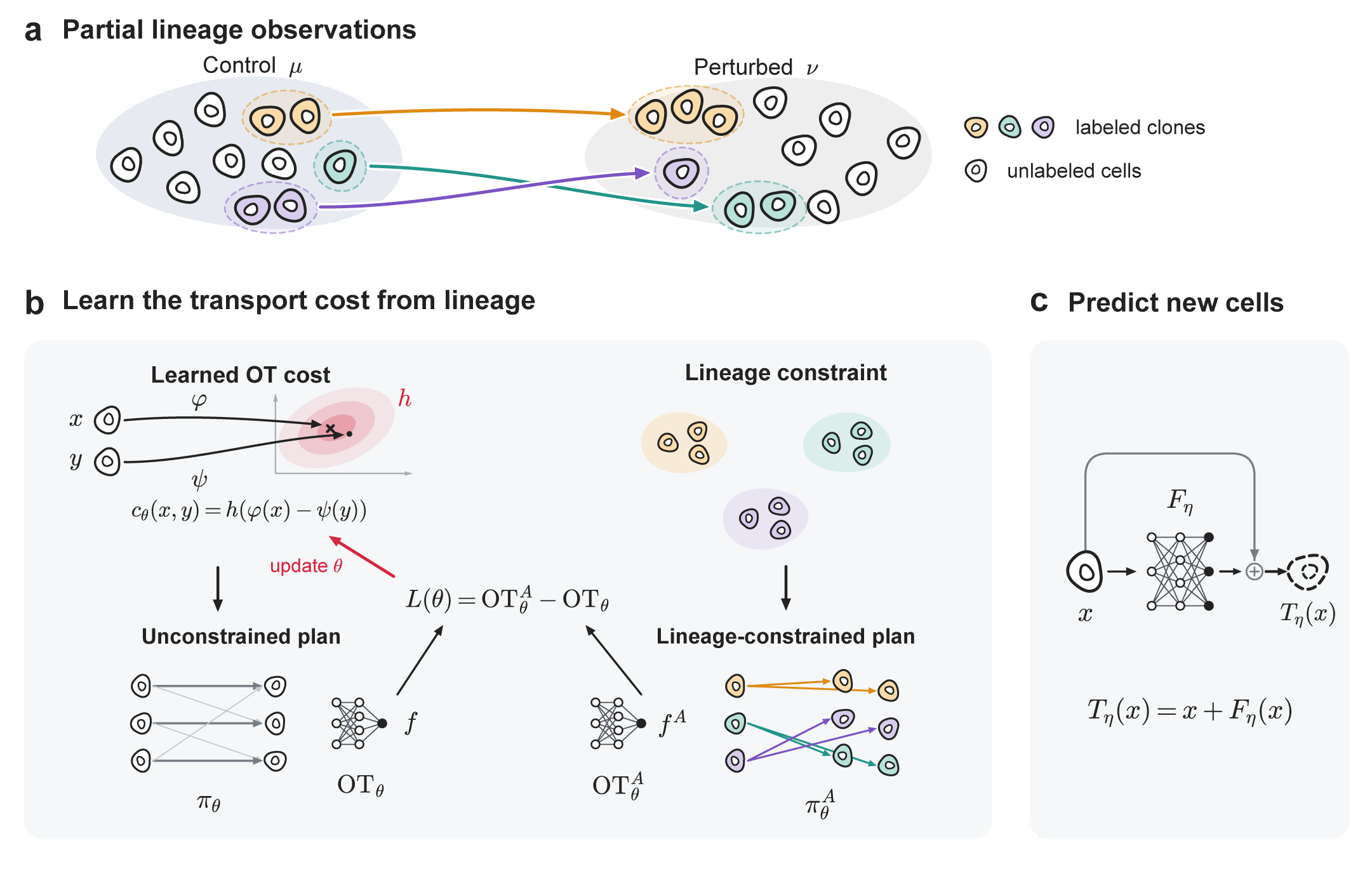
Single-cell perturbation experiments measure two unpaired populations, cells before and cells after the perturbation. Optimal transport (OT) methods such as CellOT predict the response of a cell by transporting it at minimal cost, but the cost, usually the squared Euclidean distance, is fixed in advance and may connect cells with the wrong responses. Lineage tracing links the cells of the same clone before and after the perturbation. CloneOT uses these links to learn the transport cost itself, and a neural map then predicts the response of any new cell from its expression alone.
Highlights
Learns a neural transport cost \(c(x,y)=h(\varphi(x)-\psi(y))\) from partially lineage-traced data, with neural ODE flows \(\varphi,\psi\) and a symmetric input convex network \(h\).
Needs lineage only for training. Predictions for new cells and for clones that were never labeled use their expression alone.
Works directly on AnnData: gene selection, VAE representation, cost learning, prediction and clone-level evaluation.
Trains one model in about 1.6 minutes on a single GPU.
Getting started
Reference
Questions and issues are welcome on GitHub or by email to cys@umd.edu.